What's Behind Meta's 'Why Am I Seeing This Ad?' Tool When It Comes to Political Advertising?
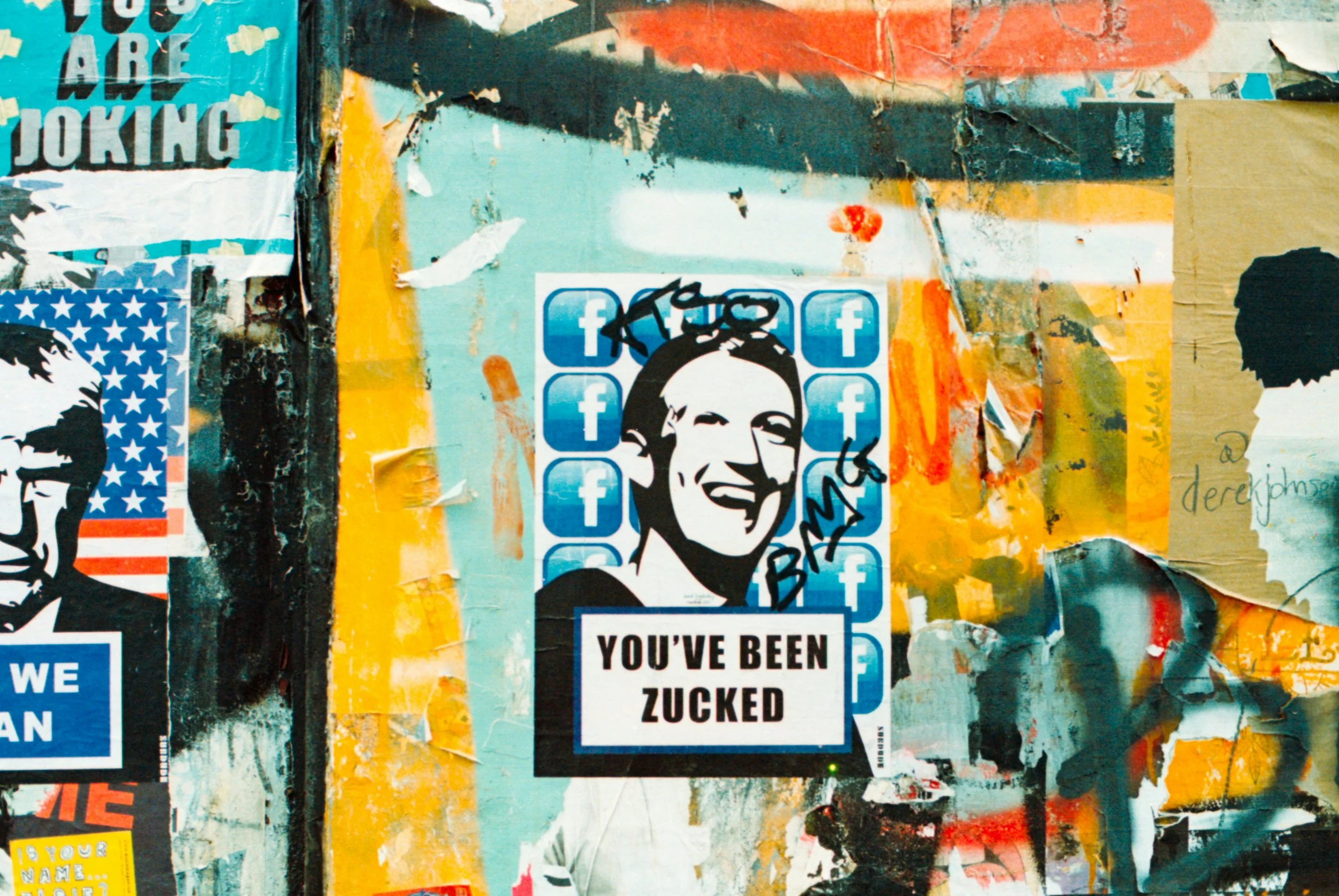
Photo by Annie Spratt on Unsplash
According to survey data from GWI, published in the DataReportal 2026 Global Overview Report, more than 2 in 3 people now use social media each month. On a global scale, Facebook currently has the largest audience of users aged 16 and above, with Instagram ranking close behind in third place. The US represents the 3rd largest internet connected population globally at 93.1% (Kemp, 2025). With New York City primaries just behind us and the midterm general elections coming up in November, political ad campaigns have been ramping up, and dominant platforms like Meta are at the forefront of that campaign strategy. We've all seen ads on Facebook and Instagram, and for the past 12 years, we've been able to use the 'Why Am I Seeing This Ad?' (or WAIST) feature, to get an explanation of why a certain ad appeared in our feed. But what is behind Meta's WAIST tool when it comes to political advertising? This project argues that while Meta presents WAIST as a transparency tool, research and legal precedent reveal it provides the illusion of transparency without delivering it, and that external regulation is the only path toward genuine political ad accountability.
What Meta Says the WAIST Tool Does
The WAIST tool has gone through several releases since it was first introduced. As noted by Burgess et al. (2024), when the tool launched in 2014 it provided only basic information such as the advertiser's name and targeting criteria. In 2016, Meta added user interests and behaviors to the explanation. In 2018, the tool expanded to include political ad source disclosures and a "Paid for by" label, alongside the launch of Meta's Ad Library, initially limited to political ads only. The Ad Library was extended to all active ads in 2019, and in 2023 a major update added machine learning explanations, which Meta framed as a significant step toward greater transparency. According to Meta (2023), the goal of this update was to make clear how machine learning shapes ad delivery, stating that this transparency "ensures that people are aware that this technology is a part of our ads system."
As the 2026 midterm elections approach, Meta has continued to expand its transparency claims. According to Meta's 2026 US Elections fact sheet, political advertisers are required to complete an authorization process and include a "Paid for by" disclaimer on all political ads, which are then stored in the publicly available Ad Library for seven years, and currently contains over 18 million US entries. Meta describes this as "industry-leading transparency" for political advertising. In the latest update, in June of 2026, Meta's election preparation page announced a new "About this ad" tool that adds disclosures for AI-generated content in political ads, presenting it again as another step toward greater accountability.
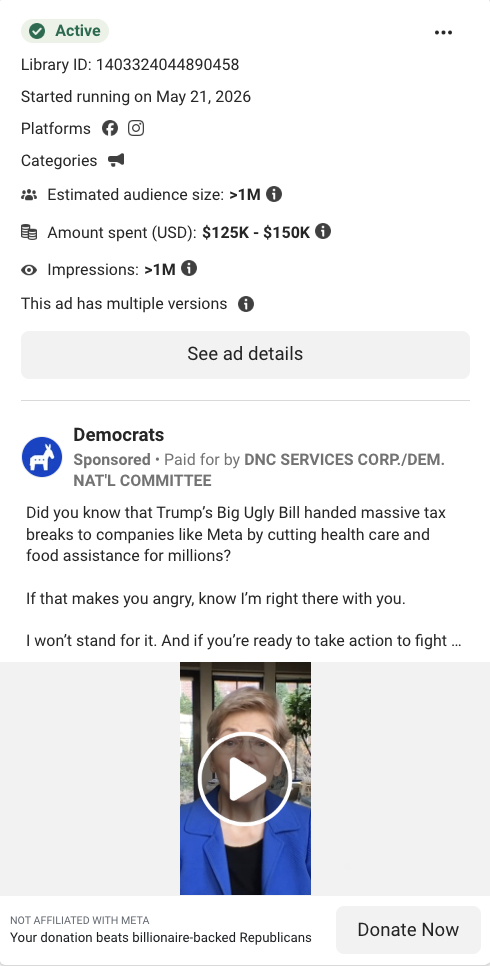
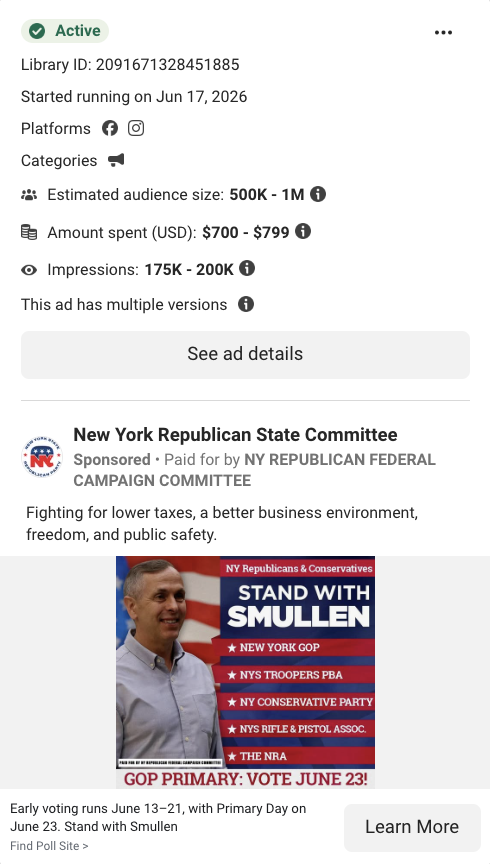
Screenshots from Meta's Ad Library showing active political ads from both major parties. The Democratic ad (Library ID: 1403324044890458) has reached over 1 million users with $125,000-$150,000 spent, while the Republican ad (Library ID: 2091671328451885) reached 175,000-200,000 users with $700-$799 spent. While the Ad Library discloses advertiser identity, spending ranges, and estimated impressions, it reveals nothing about the algorithmic logic that determined which specific users saw these ads. (Meta Ad Library, accessed July 11, 2026. https://www.facebook.com/ads/library/)
What Research Actually Found
However, research suggests that what Meta discloses about political ad delivery does not reflect the full picture. In an analysis of over 80,000 political ads on Meta during the 2021 federal election in Germany, Bär et al. (2024) found there were discrepancies between the audiences the ads were intended for and those they were delivered to. The AfD (Alternative für Deutschland), a populist far-right party, was most significantly favored by the algorithm, with their campaign ads proving nearly six times more efficient than some of their competitors, delivering more impressions per euro spent. This indicates that the algorithm may be unfairly favoring certain political parties over others, especially those with populist, controversy-driven messaging that generates higher engagement. The authors concluded that "current transparency measures do not suffice to evaluate how proprietary algorithms deliver political ads." This is a very concerning pattern that the WAIST tool is incapable of revealing to us.
Burgess et al. (2024) confirm this, finding that while WAIST provides some information about ad-buying parameters, it fails to explain why the algorithm selected that specific user, warning that WAIST data "might end up playing an obscuring rather than clarifying role" by sustaining the pretense that the targeting advertising model still works the same today as it did 10 years ago. Back then, the advertiser would select some specific characteristics based on who their target audience was and their preferences, and when described by the advertiser would lead to us seeing an ad. In reality, the model is closer to a "dynamic associative machine learning process" that works alongside some basic parameters displayed (like age and location, for example). Research found that age, gender, and location are the most commonly displayed WAIST parameters, whereas more sensitive categories like relationship status and employment were very rarely shown (Burgess et al., 2024). In addition to this, the authors noted that the tool's explanations imply linear causality, framing ad delivery as "you are seeing ad A for reason B," which is, in their words, "little more than fiction", making the explanation feel personal and logical when it is neither. Another limitation to accountability they found was that the "information about the targeting of ads is only available to individual users" and not to the public at large, which means that if you were not in the targeted group of a particular ad, you would not be able to see details on the targeted audience for that ad.
Beyond ad delivery discrepancies, research reveals why Meta may have little commercial incentive to improve transparency. Wang et al. (2025) found that Americans already report high levels of surveillance perception, which is a person's awareness and interpretation to being monitored on digital platforms, and that exposure to more detailed targeting information significantly increases negative attitudes toward personalized advertising, and that the more users learn about how they are being targeted online, the more surveilled they feel, and the more they want legal regulation of personalized advertising. This suggests Meta has a commercial incentive to keep WAIST explanations vague, as fuller transparency could drive user backlash and stronger regulatory pressure.
However, even when transparency tools are present, research shows most users don't notice them. Dobber et al. (2024) found that only 30% of users even notice political ad transparency disclosures, so while labels on political ads are helpful, they're not enough to protect voters from manipulation. One way to understand this, is to see them working as speed bumps, not barricades. So while their presence might make voters more aware of persuasion knowledge, triggering their critical and analytical assessment of the message, it doesn't take away the power the advertisers ultimately hold. The content still matters more than the size of the label, and the effectiveness relies on what the label communicates. Labels need to clearly explain why a user is seeing the ad (for example, "You are seeing this because you are a 30-year-old registered independent in a swing district"). The authors argue that instead of focusing solely on user-facing design tweaks, policymakers should focus on larger systemic regulations. This includes strictly limiting the types of personal data platforms can use for microtargeting in the first place, rather than just labeling them after the fact. This finding is particularly damaging for Meta's WAIST tool, which provides even less specific information than the disclosures tested in this study.
Meta in Court: Actions vs. Words
The research findings above raise an important question: if Meta's transparency gaps are this well-documented, why haven't they been fixed? The answer may lie less in engineering limitations and more in legal strategy. A closer look at Meta's courtroom record reveals a company whose public-facing transparency claims stand in direct contradiction to its legal actions.
In 2018, Washington State first filed against Facebook for violating campaign finance disclosure laws requiring platforms to maintain public records of political advertising. The case wound through multiple court levels over eight years, with Meta mounting First and Eighth Amendment defenses that ultimately failed. On June 18, 2026, the Washington State Supreme Court upheld the ruling, imposing a $35 million fine for 822 specific violations, the largest campaign finance penalty in US history (Campaign Legal Center, 2026; CourtListener, 2018). That a company simultaneously claiming "industry-leading transparency" spent eight years fighting a law designed to make political ad records publicly accessible speaks volumes about where Meta's true priorities lie.
Judge issues nearly $25 million fine to Facebook parent company Meta for political ad violations (NBC News, 2022). Note: the final fine was increased to $35 million by the Washington State Supreme Court on June 18, 2026.
What Real Transparency Would Require
The Washington v. Meta rulingconfirms that external pressure works, but a court victory in one state is not a substitute for a federal standard. Individual-level disclosure isn't enough. Real transparency in political advertising requires three things:
Public access to targeting data: Burgess et al. (2024)argue that a genuinely transparent system would make targeting information available to the public, not just the individual user who saw the ad, enabling population-level accountability.
Strict limits on what data can be used: Dobber et al. (2024)recommend that policymakers focus on restricting what personal data platforms can use for microtargeting in the first place, rather than simply labeling it after the fact.
Federal mandates: The DISCLOSE Act (U.S. Congress, 2026) would require digital platforms to publicly disclose records of political ad targeting, essentially federalizing what Washington State already mandated and Meta spent 8 years fighting.
As the video below shows, state-level political ad transparency regulation is already working in practice:
Montana's political ad transparency regulations show that state-level disclosure laws can work in practice. (NBC Montana, 2024)
The Bigger Picture
Meta's WAIST tool offers the appearance of transparency without delivering it, and the research and legal record make clear that external regulation, not platform self-regulation, is the only viable path toward genuine political ad accountability. For voters, what is at stake is the ability to navigate social media during election season with confidence, knowing why they are being targeted, what data is being used, and who is ultimately paying for the ads they see. If the DISCLOSE Act fails to pass, the current status quo will largely continue: 501(c)(4) nonprofits and super PACs will keep funding federal political ads on Facebook and Instagram without disclosing their original donors, and shell corporations will continue to obscure the true sources of major campaign expenditures on digital platforms. Meta is not unique in this regard. This is a broader platform accountability problem, and it is precisely why federal regulation matters. When the integrity of democratic elections depends on the voluntary goodwill of a private platform, we must realize something has gone wrong, and seriously think about who we want making the rules: the platforms profiting from our data, or the voters whose democracy depends on transparency.